The
HAL Dhruv is a utility helicopter developed and manufactured by India's Hindustan Aeronautics Limited (HAL). It is being supplied to the Indian Armed Forces, and a civilian variant is also available. The helicopter was first exported to Nepal and Israel, and is on order by several other countries for both military and commercial uses. Military versions in production are for transport, utility, reconnaissance and MedEvac roles.
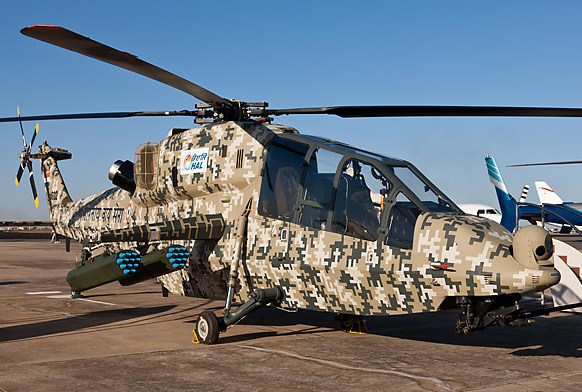
Based on the Dhruv platform, the HAL Light Combat Helicopter (LCH) a helicopter gunship and HAL Light Observation Helicopter (LOH) a utility and observation helicopter were developed.
Design

HAL Dhruv is of conventional design. About two-thirds of its empty weight features composite materials and construction. The high tail boom allows easy access to the rear clamshell loading doors. The four-bladed hingeless main rotor can be manually folded. The blades are mounted between cruciform-shaped carbon-fibre-reinforced plastic plates on a fibre elastomer constructed rotor head. The helicopter is equipped with an active vibration control system developed by Lord Corporation of North Carolina that uses sensors to monitor on-board conditions and outputs signals to actuators to cancel fuselage floor vibrations.
Dhruv's Integrated Dynamic System (IDS), which carries power from the Shakti engine to the helicopter’s rotors, was found to suffer from excessive wear and tear, requiring replacement at frequent intervals. HAL claimed to have fixed this for the Dhruv Mk III by making 6 modifications. Italian aerospace company, Avio, was hired to independently audit the wear-and-tear following the modifications.
Cockpit
The cockpit section of the fuselage is of Kevlar and carbon-fibre construction and is fitted with crashworthy seats. The aircraft is equipped with a SFIM Inc four-axis automatic flight control system. The navigation suite includes a global positioning system, a Doppler navigation system, distance measuring equipment, a true air speed indicator, automatic direction finder, a heading reference system, radio altimeter, VHF omnidirectional ranger and instrument landing system (VOR/ILS) and marker beacons. The communications suite includes HF, UHF, and VHF radio communications.
Operational History
Military service

Deliveries of the Dhruv commenced in 2002, a full ten years after the prototype's first flight, and nearly twenty years after the program was initiated. The Indian Coast Guard became the first service to bring Dhruv helicopters into service. This was followed by the Indian Army, Indian Navy, Indian Air Force and the Border Security Force. 75 Dhruvs were delivered to the Indian armed forces by 2007 and the plan is to produce 40 helicopters yearly.
One of only three helicopter display teams in the world, the Sarang aerobatic display team of the Indian Air Force performs with 4 Dhruv helicopters.
The Dhruv is capable of flying at high altitudes, a crucial requirement for the Army, which requires helicopters for operations in Siachen Glacier and Kashmir. In September 2007, the Dhruv was cleared for high-altitude flying in the Siachen Sector after six-month long trials.
In October 2007, a Dhruv flew to an altitude of 27,500 feet (8,400 m) ASL in Siachen. This was the highest that the Dhruv had flown, and was higher than the 25,000 feet (7,600 m) record set by an IAF
Cheetah helicopter in 2005.
A further order for 166 helicopters were placed with HAL since the helicopter is working well in higher altitude areas with the Indian Army.
The Armed Forces may order 12 ambulances versions for use by the Armed Forces Medical Services for MEDEVAC operations . HAL Dhruv ambulances will have all the emergency medical equipment for the treatment of injured soldiers.
In October 2008, the defence minister stated in the parliament that the Indian Navy will deploy the Dhruv in a Utility role. However, the anti-submarine version will not be pursued since it did not suit the Navy's requirements for the ASW role.
Foreign sales
The Dhruv has become the first major Indian weapons system to have secured large foreign sales. HAL hopes to sell 120 Dhruvs over the next eight years,
and has been displaying the Dhruv at airshows, including Farnborough and Paris in order to market the Dhruv.
With a unit price at least 15% less than its rivals, Dhruv has elicited interest in many countries, mostly from Latin America, Africa, West Asia, South East Asia and the Pacific Rim nations. Air forces from around 35 countries have sent in their inquiries, along with requests for demonstrations.
The first foreign orders for the Dhruv were placed by Nepal in early 2004, for 2 Dhruvs.
Another Dhruv, a civilian version, was leased to the Israeli Defense Ministry in 2004
In June 2008, the government of Peru ordered two air ambulance Dhruvs for use by the Peruvian health services.
Peru has also shown interest in the military version Dhruv.
HAL also secured an order from the Ecuadorian Air Force for 7 Dhruvs. HAL has gained this order amidst strong competition from Elbit, Eurocopter and Kazan. HAL’s offer of
US$50.7 million for seven helicopters was about 32% lower than the second lowest bid from Elbit.
5 helicopters were delivered in February 2009, during the Aero India 2009. The remaining 2 helicopters will be delivered within six months
Ecuadorian Army and Ecuadorian Navy have also expressed unofficial interest in purchasing the helicopter.
Dhruv also participated in a Chilean tender for eight to ten 5.5 tonne, twin engined new generation helicopter, but lost to the Bell Helicopters Bell 412
amid allegations of arm-twisting by the US Government.
The evaluation included flights at high altitudes, hot and desert conditions, ship deck landing, search and rescue at 12,500 feet (3,800 m) MSL at a temperature of 2°C as well as long distance ferry flights, clocking 107 flying hours.
On August 10, 2008 HAL chairman confirmed it had finalized a deal with Turkey to supply 3 Dhruvs for
US$20 million. Turkey is planning to buy as many as 17 helicopters in medical assistance role.
India is also reportedly planning to transfer several Dhruvs to Burma. This led to protests from Amnesty International, who pointed to the use of components sourced from European suppliers as a possible violation of the EU Arms Embargo of Burma.
In a
letter to the President of the EU Council of Ministers, Amnesty stated that it had evidence that India planned to transfer two Dhruvs (with European components) to Burma. These reports have been denied by the Indian Government.
HAL is negotiating with Bolivia for delivery of five Dhruvs and with Venezuela for seven of the choppers in transport roles, and in Europe.
The Dhruv is also being offered to Malaysia.
Indonesia is also evaluating Dhruv helicopters for the Indonesian Army.
Flight certification for Europe and North America is also being planned, in order to tap the large civilian market there.
On 18 April 2010. the Indian navy supplied a Dhruv to Maldives to use in Maldivian defense force in search and rescue operations.
Operators
 India
India
- Indian Army Aviation Corps (~40)
- Indian Air Force (~35)
- Indian Navy (8)
- Indian Coast Guard (9)
- Border Security Force (8 Ordered)
 Burma
Burma
- Myanmar Air Force (speculated transfer or plan to transfer although no proof exists)
 Israel
 Nepal
Nepal
- Nepalese Army Air Service (4)
 Bolivia
- Bolivian Air Force (2 on order)
 Ecuador
- Ecuadorian Air Force (7) + 2 on order
 Suriname
- Surinamese National Army - 3 on order
 Mauritius
 Maldives


 8.76 billion (US$194.5 million)